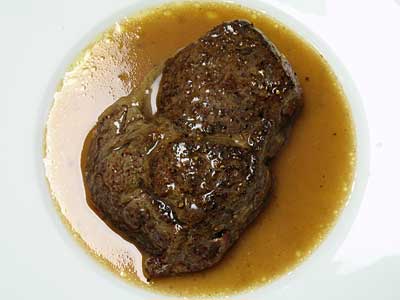
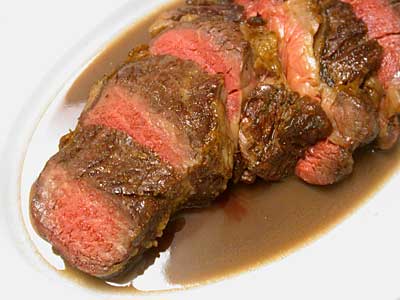
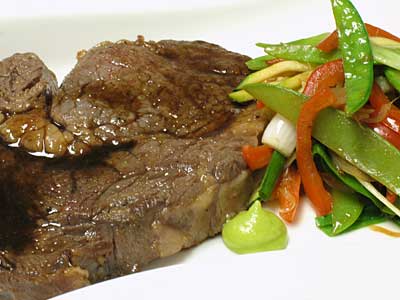
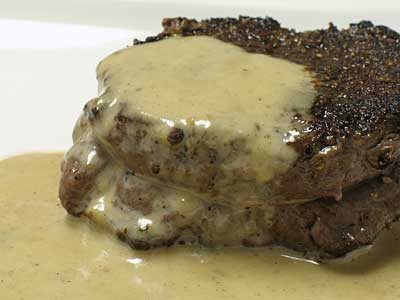
On the evening of Tuesday October 4th, 1994, my wife and I were completing our first full day in Paris. We spent the day doing some of the things that everyone does on their first trip to Paris. We visited Notre Dame—she wrote that evening “I think this whole trip was worth coming to see this complex building”—Saint Chapelle, the Concierge, and walked around Isle de Cité soaking up the sights and smells of old Paris. We walked around the neighborhood of our hotel and about three blocks away found a restaurant that looked like it had potential. While my wife enjoyed a salade de bœuf (beef salad), faux filet et frites (sirloin steak and French fries), and gâteau au chocolat (chocolate cake), I devoured terrine de maison (house terrine), rognons de veau au sauce madère (veal kidneys with Madeira sauce), charlotte des fraises (raspberry cake). I only remember all this because my wife documented all this in her travel diary later that evening.
What she didn’t write about, but we both remember quite well even today was the two men sitting opposite each other at a nearby table. Judging by their dark, pin-stripped suits, they appeared to be business men. When they weren’t eating, they maintained an animated conversation, that we couldn’t understand and smoked cigarettes. When their main course arrived, we were treated to a show that no one had warned us about. Placed on the table between them was a large wooden plank with an almost as large piece of meat. It was easily the biggest steak I had ever seen. The beast had to weigh almost a kilo (a little over two pounds). They proceeded to devour this hunk, mouthful by mouthful, by cutting off hunks with their knives and plopping the cutoff pieces directly into their mouths. Although cooked on the outside, the meat appeared raw on the inside. I now know that they were eating a côte de bœuf (beef chop) which technically speaking does not become a steak until you remove it from the bone, and it then becomes an entrecôte (rib-eye steak).
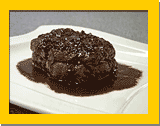

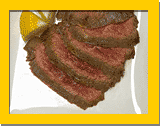
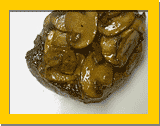
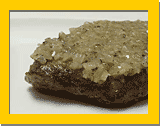
Although I was to later learn many different names for steaks in France, I noticed that I continued to see the English word steak listed on many menus and chalkboards. Steak doesn’t sound French to me. It turns out that the French have adopted the English word steak for some preparations.1 The earliest mention of steak that I found in a French-language cookbook is in Volume IV of L’Art de la cuisine française au dix-neuvième siècle published in 1843.2 An earlier English-language book of French cooking uses the word steak in its French-language recipe titles.3 The word was in common usage a century earlier in England than it was in France.
But the French have many ways of spelling steak. Besides steak there’s steck, steack, biftek, bifteck, bifsteak, and bifsteack. The last four are actually French for beef-steak, an English term almost as old as steak. Nowadays, except for bistro chalkboards displaying steak frites, the term used will be more than likely one of the French words that also denotes the position on the steer that the meat came from: entrecôte, filet, tournedo, châteaubriand, cœur de filet, filet mignon, faux-filet, contre-filet, rumsteck, bavette, or onglet. Occasionally, you can even find a good old American T-bone steak listed on a menu.
 |
|||
| French Name* | Location on Carcass | US English Name | UK English Name |
| entrecôte | [1] above the ribs | rib steak, rib-eye steak | rib steak |
| filet, tournedo | [3] slices from the center of the muscle† that lies along the back, below the spine | filet, filet mignon, tournedo | filet, filet mignon, tournedo |
| châteaubriand, cœur de filet | [3] thick sections from the center of the muscle that lies along the back, below the spine | chateaubriand | chateaubriand |
| filet mignon | [3] thick slices from the narrow end of the muscle that lies along the back, below the spine | filet mignon | filet mignon |
| faux-filet, contre-filet | [2] slices from the muscle that lies along the back, above the spine | New York strip, Delmonico, Kansas City strip, strip steak, sirloin, sirloin strip | porterhouse, sirloin |
| rumsteck | [4] large muscle high on the back near the tail, cut into thick sections | top sirloin, top round, London broil | top rump, thick flank, topside |
| bavette d’aloyau | [6] flat muscle along the side in the mid-section | hanger, skirt, London broil | skirt |
| bavette de flanchet | [7] flat muscle from the belly just in front of the leg | flank | flank, skirt |
| onglet | [5] flat muscle just in front of the filet | hanger | onglet |
|
* There are many translations available for French cuts of steak, but most do not agree in their definitions. The above chart was culled from Patrice Maubourguet (ed), Larousse gastronomique, Paris: Larousse-Bordas, 1997, in French; Jane Birch & Patrice Maubourguet (eds), Larousse Gastronomique, New York: Clarkson Potter/Publishers, 2001; and Anne Willan, La Varenne Pratique: the Complete Illustrated Cooking Course—Techniques, Ingredients, and Tools of Classic Modern Cuisine, New York: Crown Publishers, Inc., 1990. † This muscle is also referred to as the filet in French. In English it is the tenderloin. |
|||
French menus will generally list the type of steak in the dish description. The principal exception being steak frites, which is often made with a cheap cut of steak such as a thin slice of meat from the rump of the steer. In some restaurants, the weight of the steak is also listed on the menu. The common sizes being 100 grams (about 31/2 ounces), 150 grams (about 51/4 ounces), and 200 grams (about 7 ounces). There’re no Texas-size steaks in France, and steaks are rarely served on the bone.
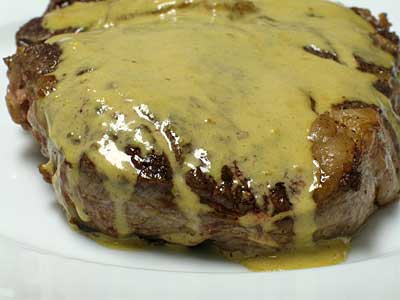
When you order a steak in a French restaurant it will usually be served with a sauce and maybe a garnish. The actual combination will be indicated by the name of the dish. Possibly the most common is entrecôte béarnaise. Nowadays the list of steak dishes is relatively short, but a hundred years ago Saulnier listed 177 different steaks dishes that were prepared with just a filet.4 He listed many more for the other cuts. Some examples are quoted below:
• Tournedo niçoise: cook in butter, niçoise garnish, serve with thickened tomato gravy.
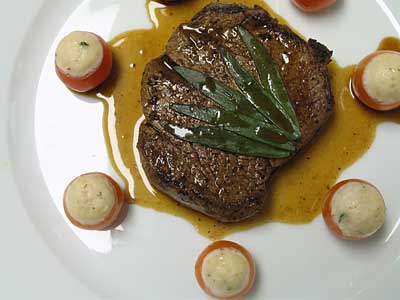
• Tournedo Saint-Gothard: grilled, dress on croûtons, set on half a grilled tomato filled with béarnaise sauce, surround with souffle potatoes.
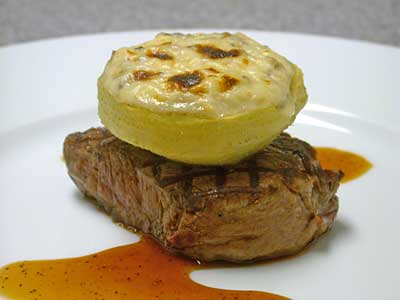
• Tournedo italienne: cooked in butter, garnish with quarters of artichoke bottoms cooked à l’italienne, served with italienne sauce.
• Tournedo castillane: cooked in butter, dressed on croûtons, garnished with tartlet crusts filled with dice of tomatoes surrounded with fried rounds of onions.
• Tournedo Vatel: cook in butter, dress on pommes Anna, border with green pea puree, garnish center with diced tomatoes, sprinkle with chopped tarragon, surround with sauteed cèpes and braised chicory, white-wine demi-glace sauce.
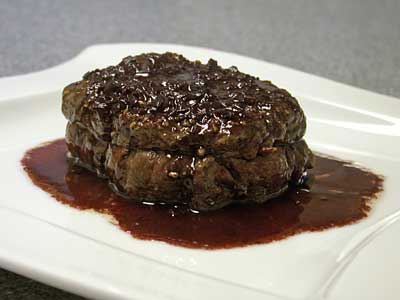
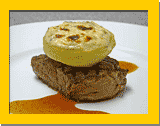
It was common in those days to serve a steak resting on a slice of crustless bread that had been fried in clarified butter and referred to as a croûton. The bread absorbed juices exuded by the cooked steak so they didn’t run around the plate and spoil the appearance of the presentation. Truffles and foie gras were also commonly part of the presentation. As archaic as some of the presentations seem today, some are still used. It’s not particularly difficult to find some variation of a tournedo Rossini—a pan-fried filet served on a crouton, garnished with a slice of seared foie gras on top, and surrounded by a ring of Madiera-flavored demi-glace—on a modern menu.
Steak recipes can nowadays be divided roughly into five groups.
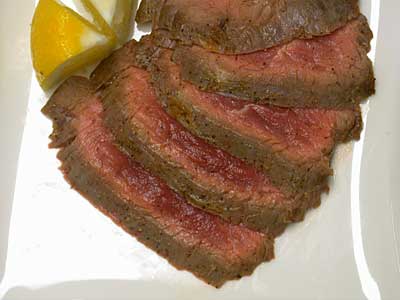
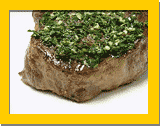
• Steaks served essentially plain, seasoned with just salt and pepper. An example is onglet le Mauzac, a plain steak served with a simple lemon wedge and named after the small café where it is served.
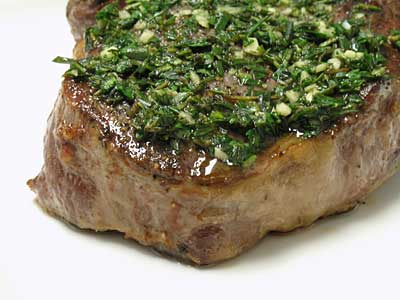
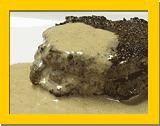
• Steaks served essentially plain, seasoned with just salt and pepper and accompanied by a sauce. Entrecôte au sauce piquante is an example from the early nineteenth century whereas entrecôte vigneronne may be considered traditional but was obtained from a modern source. Pavés du Mail is also a modern example served with a traditional sauce.
• Steaks heavily seasoned with strong spices before cooking, usually accompanied by a sauce. Steak au poivre is probably the most common example of this group of recipes. It has many variations of which a more modern, upscale version is le bifteck aphrodisiaque, the properties of which I cannot attest to.
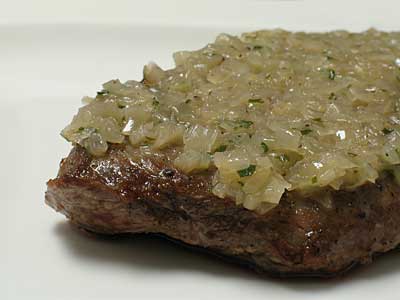
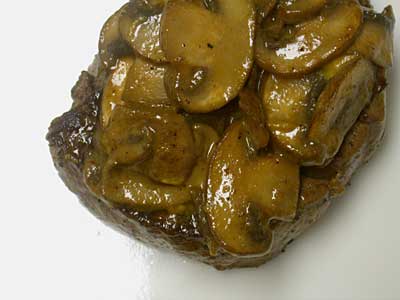
• Steaks served with a chopped or sliced vegetable topping that also acts as a sauce. The most common example of this group is onglet aux échalotes, but steak provençale and steak Joseph are also worthwhile versions; the latter of which gets its name from the restaurant where is was served in the 1950s.
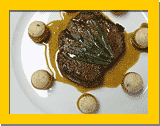
• Steaks heavily garnished with vegetables or other meats, usually accompanied by a sauce. Tournedos cendrillon is a classic example from a hundred years ago. Tournedos à la Chartres was published only a half century ago, but is as over the top as most earlier recipes of this group. A simpler, more modern example entrecôtes au wasabi, wok de légumes asiatique was published in 2006.
Although some of the recipes for steaks haven’t changed over time, the steak itself has. Nowadays steers are bred and raised to improve their tenderness. Some books from a century ago even called for cuts from the tenderloin, the most tender part of the steer, to be larded with slivers of pork fat. Some of these books are still in print. I wonder how many novice cooks search for larding needles in order to follow these recipes? Today even meat from the rump can be tender if cooked properly, i.e., not over cooked.
When ordering a steak in France, the diner specifies the degree of doneness to which the steak should be cooked:
• Au bleu is raw; only the outside heated.
• Saignant is rare; the center is perceptibly warm.
• À point is rare; the blood coagulated and the center is hot.
• Bien is what Americans would call medium.
• Bien cuit is medium well; the center is still a bit pink.5
A steak that’s cooked bien cuit will never be as tender as one cooked à point.
Isn’t it dangerous eating a raw or almost raw steak? No. As discussed in Le Livret de température des viandes (The Little Book of Meat Temperatures) the bacteria that are occasionally found on raw meat are only present on the surface. When the steak is seared, these bacteria are instantly killed.
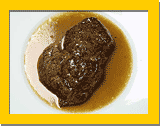
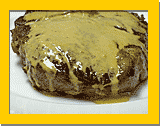
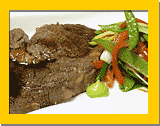
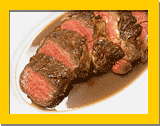
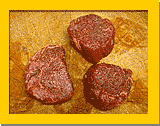
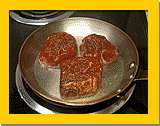
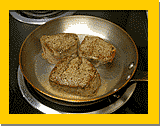
Depending upon the thickness of the steak, cooking should be be either a two- or three-step process. The first step is to sear the outside of the steak with intense, dry heat. If it is thin, it only needs to be seared on two sides, but if it is thick, the edges should also be seared. Contrary to a century and a half-old myth that searing helps to seal in the juices of the steak, the reason to sear the meat is flavor.6 This flavor and color is a result of the Maillard reaction that produces a complex group of molecules that we find pleasing.7
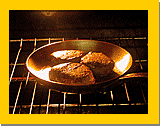
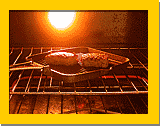
The second step, that can be skipped only for very thin cuts of meat, is roasting in dry, high heat. As good as searing is, a thick steak cooked totally in a hot frying pan would be thoroughly overcooked at the outer surfaces by the time the interior was sufficiently cooked. By doing the majority of the cooking in an oven, the heat can penetrate the meat from all sides and thus cook it evenly.
The final step is to let the piece of meat rest in a warm environment. It is difficult to produce a properly cooked steak if you try to cook it completely over heat and then serve it immediately. Resting is a very important part of the process. When removed from the heat, the meat will continue to cook until it is sliced. A “perfectly” cooked steak will become overcooked if the resting process is not included in the overall cooking process. This process is also explained in detail in Le Livret de température des viandes. As a result of proper resting, a thick piece of meat is cooked evenly throughout.
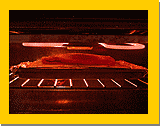
Traditionally in France, steaks were either pan-fried or grilled. Nowadays, broilers or salamanders may also be used. Except for very thin cuts, all these methods are used for searing. They are usually used in conjunction with oven roasting to “finish” the meat. In a fine restaurant resting will take place in a warmer. All these cooking methods can be easily done in a home kitchen.
I don’t recall ever seeing a recipe for a steak in a French cookbook or cooking magazine that called for the steak to be marinated. I did work in a Michelin one-star restaurant in the Alsace where some meats were marinated, but the chef had worked a number of years in the United States and maybe he leaned to marinate there. When I was growing up, marinating was thought to make steaks more tender, but experience has proven otherwise. At best, marinating will affect the flavor of the outer few millimeters of the meat unless left to soak for many days that can cause the meat to seem mushy. Some cooks recommend injecting the marinade into thick pieces of meat, but I have not seen this method advocated in France. Once again, the best way to produce a tender steak is to not overcook it.
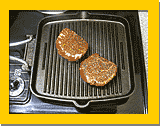
When pan-frying a steak, it is important to use a heavy frying pan with an uncoated surface for the searing process. A stainless steel-lined copper or aluminum pan works quite well, as does a well-seasoned cast iron pan. All of these can be heated dry to quite a high temperature before the steak is added. Some fat, usually oil or butter, is added to the pan just before the searing begins. The meat will usually stick to the surface of the pan initially, but will release when it is sufficiently seared. The frying pan should be large enough so the pieces of meat aren’t crowded. It is important that any juices released by the meat are allowed to evaporate. If the juices are allowed to accumulate in the pan, the meat will be boiled instead of seared.
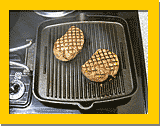
A cast iron pan with raised ridges on the surface can be used to sear the meat with “grill” marks. If this type of frying pan is used, the meat is usually rotated 90 degrees part of the way through the searing process on each side so two sets of lines are produced. This is done for the visual effect more than for flavor. One benefit of the ridges is that they hold the meat above any juices it releases and the cooking surface remains dry.
When more steaks are to be cooked than will fit comfortably in the frying or grill pan without crowding, they can be seared in batches and then set aside for roasting in quantity during the second phase. After searing the steaks, transfer them to a baking sheet. A number of baking sheets can be placed in the oven at one time.
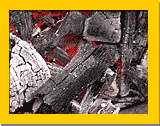
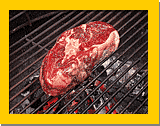
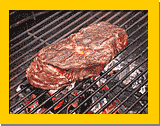
When searing a steak on a grill over wood, charcoal, or gas, it is important that the heat be as high as possible. With wood, all of the flames should have died down leaving just glowing hot coals. The steaks should be dried with absorbent paper before seasoning and brushed lightly with vegetable oil just before placing on the grill. You want to avoid flare-ups that would cause carbon to be deposited on the surface of the meat. The carbon is usually produced by fat dripping on the coals and gives the surface of the meat a bitter taste.
To turn the meat, I prefer to use tongs. In France, I usually see chefs using a long meat fork to turn meat, but I think that tongs provide a better grip. Some cooks claim that a fork will cause a loss of juices because it pierces the meat, but I don’t think this juice loss, if any, is significant.
The roasting phase of the cooking, if started in a frying pan, can be completed in the same pan or on a baking sheet if the frying pan is needed for other cooking needs. Most of the time I preheat my oven to 220 °C (425 °F) for the roasting. I usually cook the meat until the internal temperature reaches between 45 and 50 °C (110 and 120 °F), but I may remove a very thick steak at 40 °C (105 °F) because its internal temperature will rise more during resting.
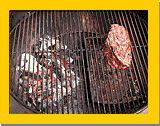
If the searing is done on a grill over wood, charcoal, or gas, the steak is moved to a place on the grill where the heat is indirect and the grill is covered. When I cover my kettle-style grill that has a nice pile of glowing charcoal off to one side, the temperature inside can easily rise to 240 °C (465 °F) over by the steaks on the other side. If your grill cannot be covered, the roasting should be done in an oven.
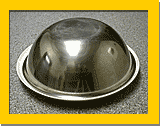
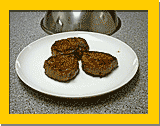
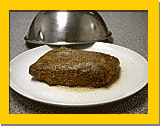
For the final phase of the cooking—resting—I keep the steak in the frying pan in which it was cooked. If I want to make a pan sauce in the frying pan, I transfer the steak to a warm plate. In either case, the plate or frying pan is covered with a metal bowl and a couple of towels are thrown over the bowl. If the steak was cooked on the grill then a warm plate is used. If the steak was cooked on a baking sheet, I invert a second baking sheet of the same size over the first. As a last resort, I will tent the steak with foil. To keep the resting meat out of drafts, I use a couple of small quilts that were sewn for me to use specifically for covering meat. A couple of heavy towels will also provide sufficient insulation. The thicker the steaks, the longer I let them rest. Five minutes is my minimum time for thin steaks and ten minutes for thick ones. Covered as described above, they can sit quite a long time and remain warm and perfectly cooked. As an alternative, they can be covered with foil and kept in a 70 °C (160 °F) oven.
Won’t the steaks become contaminated with airborne bacteria while resting? No. As long as the steaks remain covered, bacteria will not be able to collect on the surface. Remember, the surface was hotter than 70 °C (155 °F), the lethal temperature for the bacteria, before it was covered.
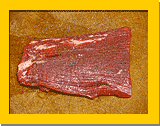
My favorite steak is the entrecôte (rib eye). I think it is tastier than the filet and I like having to chew a little. Where I purchase my steaks, the butcher cuts them to order so I usually get one that’s about 400 grams (a little less than a pound). More often than not, I pan-fry it and serve it simply with a little crème de raifort (horseradish) or a simple sauce with a demi-glace base.
Whether plain or fancy, steaks served in the French style can be very tasty and not particularly difficult to prepare.

The English attribute the word steak to Old Norse, a language that preceeded both Swedish and Danish, which have similar words. The Oxford English Dictionary. Oxford: Oxford University Press, 2nd ed, 1989. OED Online, 12 May 2006 <http://dictionary.oed.com/cgi/entry/50236623>
Marie Antonin Carême & Armand Plumerey. L’Art de la cuisine française au dix-neuvième siècle: Traité des entrées chaudes, des rots en gras et en maigre, des entremets de légumes, entremets sucrés et autres. Paris: Au Dépot, rue Thérèse, 11, 1843. Facsimile by Adamant Media Corporation (Chestnut Hill MA), 2004. Vol. IV.
—. French Domestic Cookery, Combining Economy with Elegance, and Adapted to the Use of Families of Moderate Fortune, by an English Physician, Many Years Resident on the Continent. London: Thomas Boys, 1825. NB: Except for William Verral’s A Complete System of Cookery (London, 1759), which was a book of recipes “collected from several years experience under the celebrated Mr. de St. Clouet, sometime since cook to his Grace the Duke of Newcastle,” and Ude’s The French Cook (London, 1813), written by the former cook to Louis XVI, this is possibly the first book of French cookery written in English that is not a translation. While Verral’s and Ude’s books stemmed from the kitchens of royalty, this book is about French domestic cooking.
Louis Saulnier. E. Brunet (trans). Le Répertoire de la cuisine. Staines, Middlesex UK: Leon Jaeggi & Sons Ltd., 1982. Originally published in 1914.
Alma Lach. Hows and Whys of French Cooking. Chicago: The University of Chicago Press, 1974, p 219.
Around 1850, the German chemist Justus von Liebig proposed the concept that searing would seal the juices in a piece of meat because the surface albumen coagulates forming a crust. This theory was disproved in the 1930s. See Harold McGee, On Food and Cooking, New York: Simon & Schuster, 2004, revised edition, p 161.
Ibid, p 778-9.
©2006, 2014 Peter Hertzmann. All rights reserved.